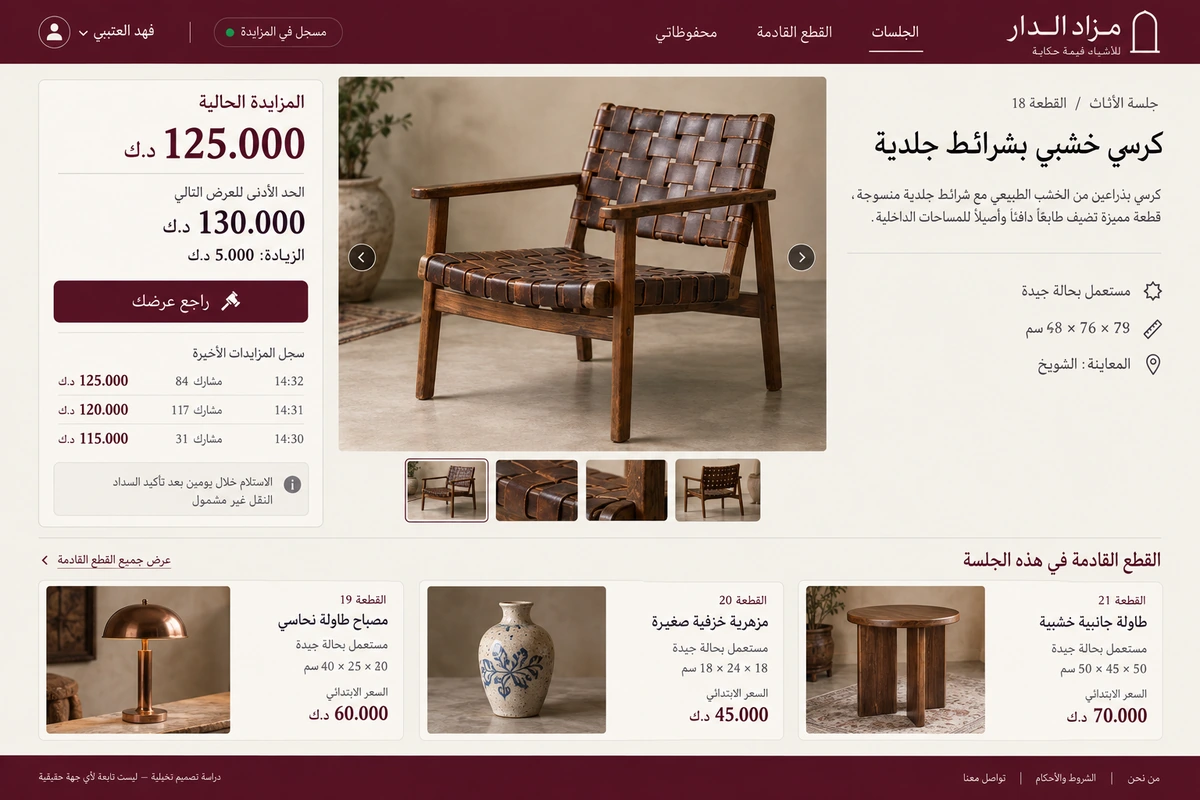
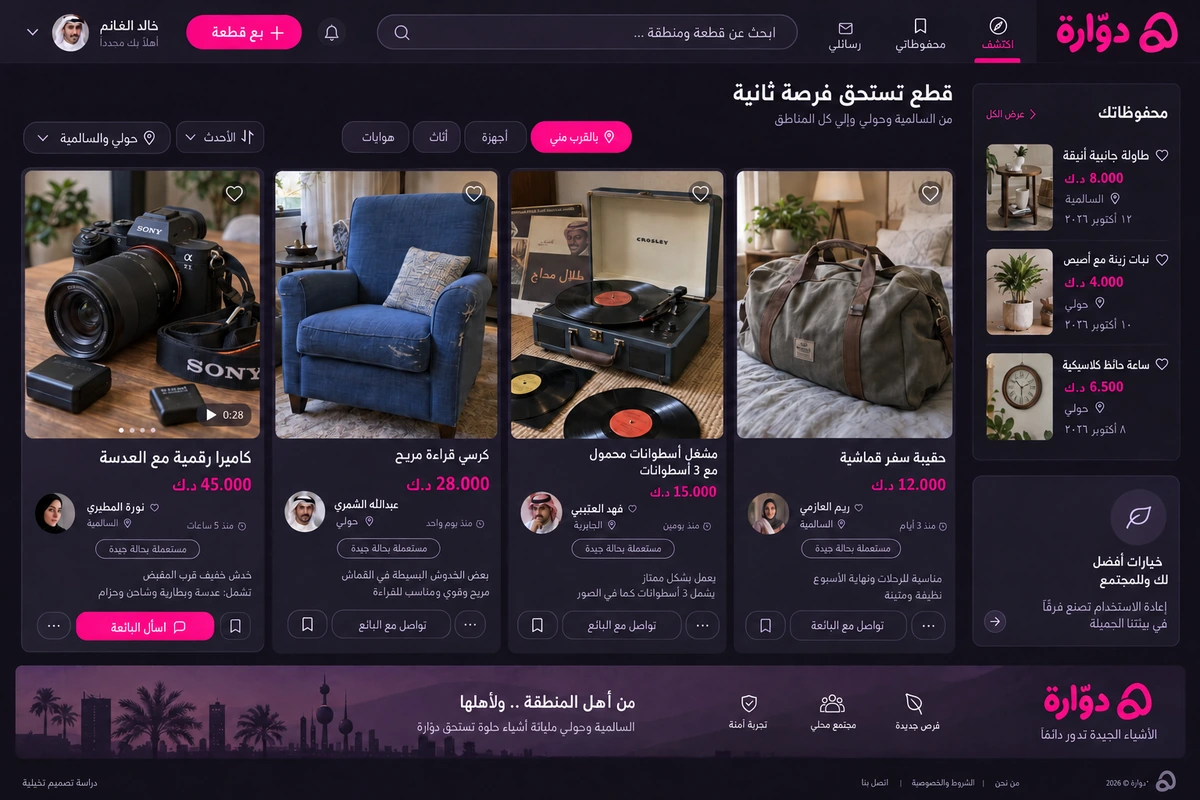
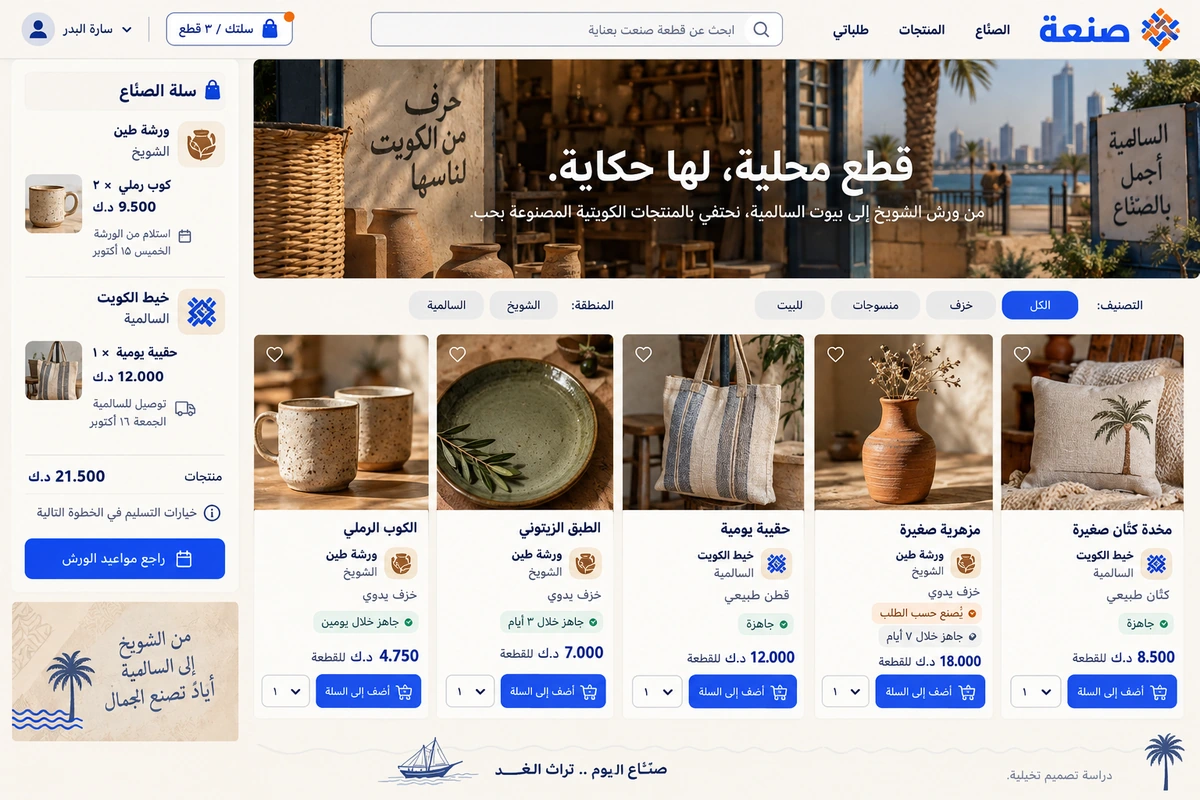
Point of sale and inventory Design concept
Rukn
An Arabic café POS linking cashier orders, stock, shifts and sales saved during connection loss.
We designed Rukn as a fictional Salmiya café client that needed a clear, fast counter experience during busy service. One hand selects a product, one glance checks quantities and amounts, and another employee needs to understand remaining stock. Sales, receiving and connection status share one Arabic identity, with customer-facing information separated from shift operations.
Client in the design study
Rukn Salmiya Café
Salmiya, Kuwait
Project brief
A fictional small-café client for an Arabic POS and inventory product handling shifts and takeaway orders.
Design scope
- Arabic operational product identity
- Cashier, current order and payment interface
- Stock receiving and synchronization status
01 / The project challenge
The project challenge
A drink name is not enough to prepare an order: size, milk and extras must remain attached to the correct line. Connection loss also needs an explicit saved state so the cashier does not repeat a sale. Inventory mixes kilograms of beans, liters of milk and individual pastries; quantities become misleading without their units and alert thresholds.
02 / The solution we designed
The solution we designed
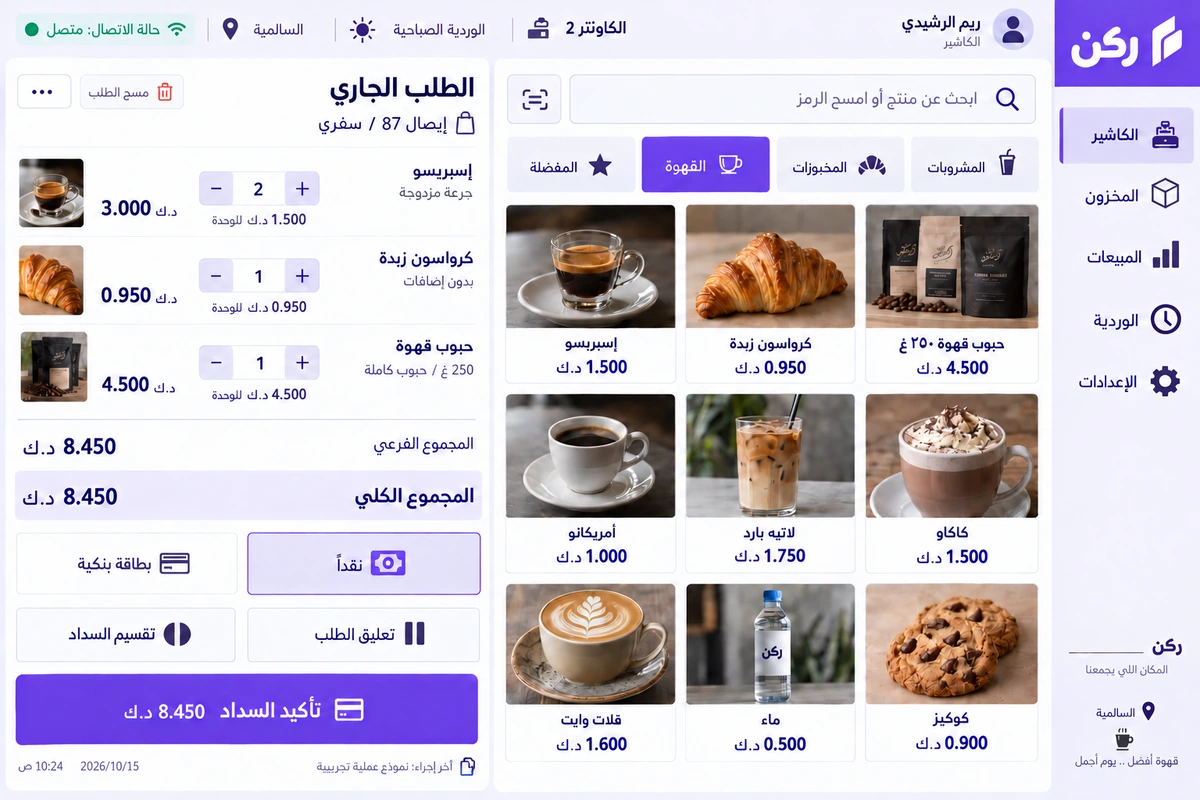
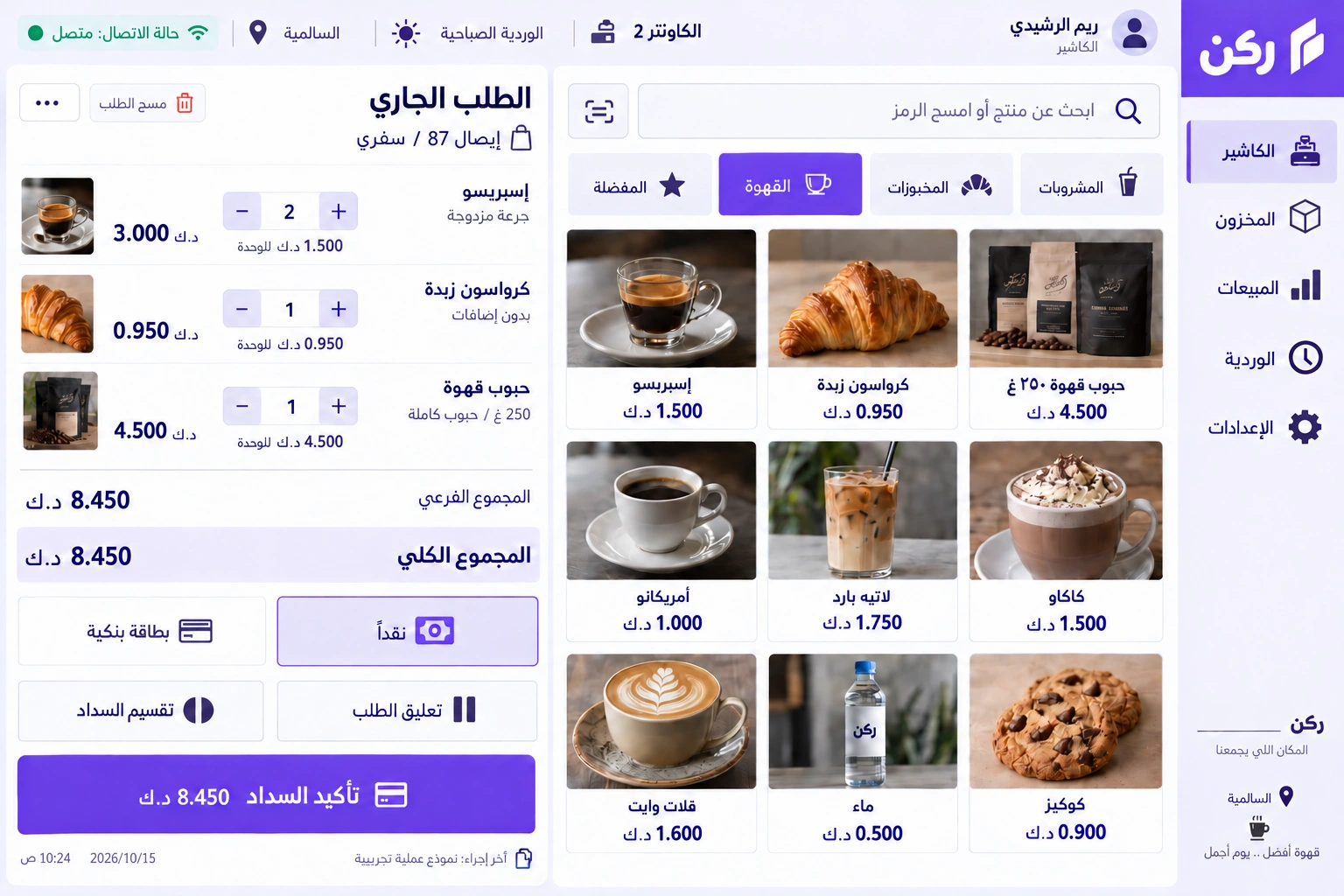
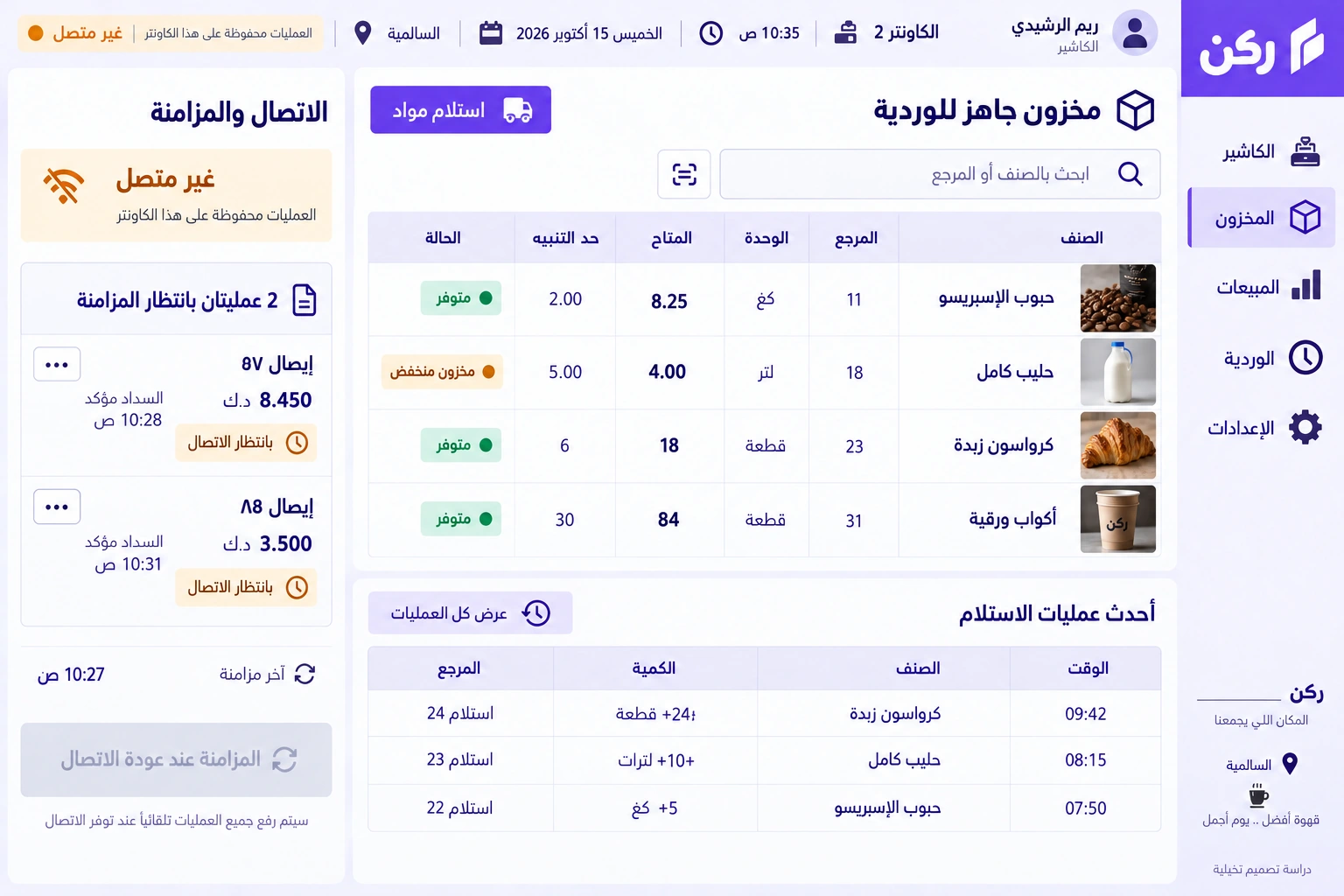
The checkout uses large product keys, café photographs and concise labels. A separate current-order column retains quantities, modifiers, held-sale and split-payment actions. Inventory lists item code, unit, available quantity, threshold and state, with timestamped receiving activity. An offline panel identifies saved receipts and amounts waiting to sync rather than hiding earlier transactions.
03 / The experience
The experience
Reem Al Rashidi prepares a takeaway at counter two: two espressos for 3.000 KD, a butter croissant for 0.950 and a bag of beans for 4.500, totaling 8.450 KD. After payment confirmation, receipt 87 appears in the waiting queue when the connection drops. Inventory shows four liters of milk against a five-liter alert threshold, with eighteen croissants available. Reem can review the latest delivery before requesting more stock.
04 / What it could do
What it could do
Reviewable orders
Quantity, line amount and drink modifiers remain beside each product before payment.
Explicit units
Kilograms, liters and pieces appear with quantities and thresholds for meaningful comparisons.
Saved transactions
Each waiting sale has a receipt number, amount and confirmation time so the cashier understands its state.
Organized shifts
Receiving, held orders and counter status support practical checks during and after service.
05 / A typical journey
A typical journey
Build the order
Select products and change quantities, milk and extras on their own lines.
Confirm payment
Review the amount and see a receipt and explicit result state.
Check stock
Read availability, thresholds and receiving activity in the correct units.
Follow connection status
Review waiting transactions and synchronization without losing earlier order context.
06 / Inside the interface
Inside the interface
Arabic interfaces with right-to-left reading and sample workflows set in Kuwait. Open the images to explore the details.
Explore the screens.
Open any screen to explore the complete project gallery.
07 / Design direction
Design direction
A vivid purple and white palette with light lavender supports a balanced Arabic Rukn wordmark. Secondary text remains readable rather than washed out. Written states accompany colors, large amounts anchor checkout, and compact units/codes align inventory. Product photography belongs to the café scenario; operational space is not occupied by promotional slogans.
Discuss a similar idea